Buying property abroad is a major decision – which is why it’s important to approach the process methodically and thoughtfully. Below, we present a practical step-by-step guide – from setting priorities to working with your chosen real estate agency. The best way to start your search for your dream property in Spain is by finding the right real estate agency.
What will you read about in this note?
- A guide for property buyers on the Costa del Sol
- Buying property on the Costa del Sol – step by step
- 1. Flat or villa on the Costa del Sol?
- 2. Define the purpose of buying property in Spain and your budget
- 3. Are you wondering whether to choose the secondary or primary market?
- 4. Choose a property agency in Spain to guide you through the entire buying process
- 5. A visit to view properties in Spain
- Why choose Agnes Inversiones estate agency?
- Summary: what to look out for when buying property in Spain?
A guide for property buyers on the Costa del Sol
In Andalusia, there is no exclusive listing system, which means that most properties are listed simultaneously with several estate agents. That is why it is worth choosing a single, trusted partner who will guide you through the entire process – from the initial consultation to the handover of the keys – as well as providing support and after-sales service.
An agent who understands your needs can better respond to changing priorities, suggest suitable properties and genuinely support you in making the right decisions. It is not just about ‘showing properties’, but providing real support throughout the process and protecting you from potential problems. Importantly, in Andalusia, the estate agent’s fee is always paid by the seller.
The first contact is usually a brief phone call, during which the key features of the property you are looking for are established: type, location, budget, and purpose of purchase (a permanent home, a holiday home or an investment). The agent then prepares a shortlist of properties and sends it to you – this is the time to clarify your expectations. You will also receive further new offers as they become available. The next step is an on-site visit, ideally planned for a few days, combining property viewings with meetings with a solicitor and the bank.
Buying property on the Costa del Sol – step by step
Before proceeding with the purchase of property in Spain and deciding whether it should come from the secondary or primary market, it is worth verifying all the formal requirements. A buyer of a house or flat in Spain should have:
- an N.I.E. number (Número de Identidad de Extranjero) – this is the equivalent of the Polish tax identification number (NIP) (read how to obtain it),
- a bank account in Spain,
- a notarised power of attorney,
- a document confirming separate property (if applicable),
- a valid identity document,
- documents confirming the legal origin of the buyer’s funds (e.g. income from professional activity, sale of another property, savings, inheritance).
1. Flat or villa on the Costa del Sol?
Before you start browsing listings, ask yourself the key question: what type of property are you interested in?
- Flat or penthouse: easy to maintain, often in estates with swimming pools, security and shared facilities.
- Townhouse or semi-detached house: a compromise between an apartment and a detached house.
- Villa: privacy, space, a garden, but also higher maintenance costs.
The choice depends partly on your budget, but mainly on your lifestyle.
Flats are easy to manage – you simply ‘lock the door’ and don’t have to worry about maintaining a garden or swimming pool. Flats are always located in estates managed by residents’ associations. It is to this association that you pay the rent, known as the community fee.
With a villa, you have significantly more privacy, but you bear the full costs of maintaining the property yourself. You also need to take care of all sorts of repairs, pool and garden maintenance, and cleaning. In most cases, houses are located in housing estates, and in such cases, the running costs include an estate fee for maintaining green spaces or lighting the pavements in communal areas.
2. Define the purpose of buying property in Spain and your budget
The next step is to clearly determine how much you can allocate to the investment and what your expectations are.
Take into account whether you have the full amount available or plan to take out a mortgage – Spanish banks usually require a deposit of 50% of the property value.
Consider whether you are interested in a modern flat near the beach, a quiet house in the suburbs, or perhaps a luxury villa with a sea view. Clearly defining your budget and preferences significantly narrows down and simplifies the search for the right property.
Additionally, please note that all property prices quoted in listings and on online portals are net prices, to which you must add – depending on whether it is the secondary or primary market – between 8% and 13% (this also includes the costs of applicable taxes, notary fees and legal services).
Regardless of the form of financing – cash or mortgage – we offer full support at every stage. Banks for non-residents usually finance 50–60% of the property’s value, which means you need to have 40–50% of your own funds,
Ask yourself why you want to buy a property on the Costa del Sol? What form of use/purpose will it serve for you?
- For your own use: comfort, lifestyle, proximity to school/work.
- For rental: profitability, seasonality and tourist demand.
- Mixed use (own and rent): you use it when you want, and when you’re away, you rent it out.
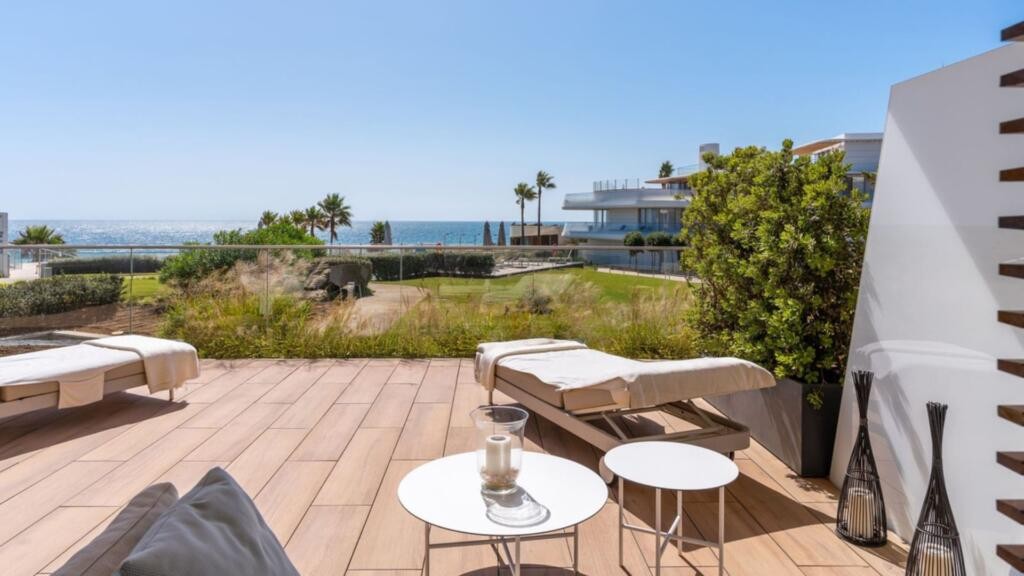
3. Are you wondering whether to choose the secondary or primary market?
The primary market in Spain
- New properties: often with modern amenities, requiring no renovation.
- You often buy ‘off-plan’, which means a waiting period before handover (e.g. 1–2 years).
The secondary market in Spain
- Existing houses and flats – often in better locations and with the possibility of price negotiation.
- Sometimes they require renovation or modernisation.
During the initial search phase or even on your first visit, we recommend viewing properties from both the Spanish primary market and the secondary market, which may help you make your final decision.
4. Choose a property agency in Spain to guide you through the entire buying process
In Andalusia, there is practically no exclusivity, so one agency’s portfolio often covers 99% of available properties.
However, it is worth choosing a single, trusted agent who:
- will conduct a detailed consultation with you about your needs,
- will match properties to your lifestyle, budget and purpose of purchase,
- knows the local market and the region’s topography,
- will respond to changes in your priorities,
- will provide support at every stage of the process.
It is an agent who understands your needs (e.g. “I need to be close to schools”, “a sea view is important”, “I want to be near golf courses”) who can find a property that suits you more efficiently.
In Andalusia, the agency fee is always paid by the seller – so you can use the agent’s services at no extra cost.

5. A visit to view properties in Spain
Once the list of properties is ready, the best way to make a decision is to spend a few days in the region.
During your visit:
- you’ll meet with a local agent,
- view properties,
- it’s also worth arranging meetings with:
- a mortgage advisor/bank.
- a solicitor (familiar with local regulations),
Why choose Agnes Inversiones estate agency?
Agnes Inversiones is the oldest and most recognisable estate agency with Polish roots on the Costa del Sol, supporting clients throughout the entire purchase process – from the first contact right through to after-sales service.
Our strengths:
- over 20 years’ experience on the Costa del Sol,
- hundreds of completed transactions,
- service in Polish, Spanish, English and German,
- thorough knowledge of the law, local conditions and procedures in Andalusia,
- collaboration with solicitors, notaries and financial advisers,
- support at every stage (negotiations, contracts, mortgages),
- comprehensive assistance after the purchase too: management, letting and consultancy.
- long-term partnership – we help not only with buying a property, but also with maintaining it effectively, letting it out and developing its investment potential.
We are active within the local community and the international LPA network, an association of leading agencies specialising in the sale of luxury properties on the Costa del Sol. LPA members are bound by a code of ethics in their dealings with clients.
As a responsible company, Agnes Inversiones also holds civil liability insurance covering up to €2 million.
Summary: what to look out for when buying property in Spain?
To go through the process of buying property in Spain step by step, stress-free and, above all, with a sense of fulfilment, start by choosing a property agency that will not only help you set your priorities but also support you at every stage of purchasing a specific property. When buying a property, it is worth noting that the prices quoted on websites are net figures, to which tax, as well as notary and legal fees, must be added.
If you are planning to take out a mortgage, it is worth submitting your mortgage application at least two months in advance so that all formalities are ‘sorted’ by the time the deed is signed. You can read about how to obtain a mortgage in Spain for non-residents on our blog.
First and foremost, it is worth considering the purpose of buying a property in Spain – whether it will be your permanent home or perhaps a holiday let that you will mainly use during the holidays. It is also important to choose an estate agent who will support you at every stage of the transaction. Read more about the process of buying a property in Spain.
On our website, you’ll find a list of apartments and houses for sale across the Costa del Sol, including in Marbella. Simply go to the ‘Property’ > ‘For Sale’ tab and set the location filter to Marbella. You can also apply other filters to help you find the property that best suits your needs.
Choosing the right estate agent ensures that you are guided safely through the entire buying process – from the initial contact right through to the purchase of the property and post-transaction support. It is worth paying attention not only to the comprehensive customer service that the agency should offer, but also to its experience. It is worth considering working with a local agency that knows the Costa del Sol well and is thoroughly familiar with the regulations and the formal language used by banks and solicitors.