Your own holiday home or home swapping? What would Poles choose?
Why Spain and the Costa del Sol?
Home swapping – that is, temporarily making one’s own house or flat available in exchange for a stay in someone else’s property – is gaining popularity in some European markets. In Poland, however, this model remains little known and is met with marked reserve. In a Signature Estates survey, the results of which were published by CBRE, 12 per cent of respondents stated that they would consider this form of holiday. In a separate question, 45 per cent of respondents indicated that, given the financial means, they would purchase a property in a location attractive to tourists, either for their own use or to let out.
Home swapping, also known as home exchange, house swapping or home exchange, involves making your own house or flat available to other people in exchange for the opportunity to use their property. In the traditional form, the two parties simply swap homes for a specified period.
However, it does not always have to be a ‘one-to-one’ exchange taking place at the same time. Modern platforms also allow for non-simultaneous exchanges. One example is the HomeExchange points system: a homeowner can host guests, receive points in return, and use them later for a stay at someone else’s property.
Home exchange primarily helps to reduce accommodation costs, although this does not mean that using such services is always completely free – the platforms may charge a membership fee. The model is also based on trust between users, a rating and identity verification system, and the establishment of rules for using the property.
Home swapping isn’t a new idea. What is new are the platforms and apps
Although home swapping may seem like a relatively new trend linked to the development of apps and the sharing economy, the idea itself is over 70 years old.
Intervac, one of the oldest home-exchange organisations, was founded as early as 1953. Its origins lie with a group of European teachers who were looking for a cheaper way to travel and who swapped their homes with one another whilst on holiday.
Above all, the scale and technology have changed. The old catalogues, lists and telephone calls have been replaced by online platforms and apps that allow users to search for properties all over the world, check availability, view profiles and read user reviews, and finalise the details of the exchange.
Where is home swapping most popular?
Home swapping is no longer a small niche in the tourism sector. HomeExchange currently reports that its community has over 300,000 members across 155 countries. The platform also claims to hold an approximately 80 per cent share of the home-swapping market.
The strongest markets are primarily the countries of Western Europe and North America. According to figures released in early 2026, France had the largest HomeExchange community – around 90,000 users, followed by Spain – 40,600, the United States – 30,000, Canada – 18,000 and Italy – 11,000.
Growth is also strong. Data from HomeExchange, cited by CBRE, shows that over the course of a year, the number of users in France rose by around 50 per cent, and in Italy and Spain by over 40 per cent.
Spain is therefore one of the markets where home swaps are growing particularly rapidly. In 2025, the platform recorded a 43 per cent increase in the number of swaps there.
Home swapping is used for both traditional holidays and longer stays. Some platforms also target people who combine travel with remote working.
Home swapping in Poland – privacy and control are more important than saving money
In Poland, the situation is quite different. Half of the participants in the Signature Estates survey admitted that they had never heard of home swapping before. A further 40 per cent were familiar with the term or the concept, but did not know exactly what it involved. Only one in ten respondents said they had a good understanding of how it works.
Even after the rules had been explained, only 12 per cent of respondents would consider this type of trip, whilst 73 per cent would not consider it.
The problem here is not merely a lack of awareness of the scheme. The findings reveal clear psychological barriers associated with allowing a stranger into one’s own home:
64 per cent of respondents are worried about the condition of their flat when they return,
55 per cent value having control over their own property more highly than the savings associated with travelling,
36 per cent point to the need for privacy,
One in ten respondents is put off by the organisation of the entire exchange process.
This shows that, for most Poles, the savings on accommodation do not make up for the feeling of losing control over their own home.
Your own holiday home instead of a home exchange
Respondents take a completely different view of ownership of holiday properties.
As many as 45 per cent of respondents say that, if they had the financial means, they would choose to buy a flat or a house in a popular tourist destination – either for their own use during the holidays or with a view to letting it out. Thirty per cent of those surveyed would not consider such a purchase.
Nearly four in ten Poles consider a holiday home to be a good investment, despite the costs associated with maintaining it. They cite the potential for the property’s value to increase and the income from letting it as among the potential benefits.
The results therefore show a clear difference between the two approaches. Home swapping involves letting strangers into your own home in exchange for the opportunity to use another property. Owning your own holiday property, on the other hand, allows you to retain control over the property, use it according to your own needs and, at the same time – depending on local regulations and market conditions – generate income from letting it out.
What sort of properties in Spain are Poles looking for?
This interest in property is also evident in the actual purchases made by Poles abroad. In the first half of 2026, Polish buyers purchased 2,269 houses and flats in Spain, nearly 9 per cent more than in the previous year.
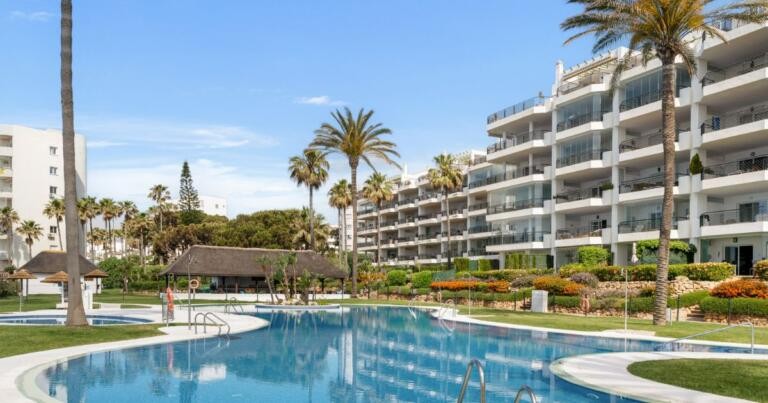
Among clients with a budget of up to 500,000 euros, the most sought-after properties are two-bedroom flats with a terrace and a swimming pool, situated in a location offering good access to the beach and local amenities. At the same time, the value for money, rental potential and the prospect of a future resale are becoming increasingly important factors in investment decisions.
In the case of properties purchased primarily for personal use, however, what matters most are the location, standard, view, proximity to the beach and access to year-round facilities.
A property for your own use or to let?
In practice, these two objectives are increasingly being combined. An apartment on the Costa del Sol may be used by the owner for a few weeks or months each year, and for the rest of the time – provided that applicable regulations allow it – it may be let out.
This solution allows people to retain what – as the Signature Estates survey shows – Poles expect from property: ownership, control and the ability to use it on their own terms, whilst at the same time offering the opportunity to treat the purchase as part of an investment portfolio.
However, this approach requires proper property management, particularly if the owner spends most of the year in Poland. Agnes Inversiones provides services both to individuals buying a house or flat for themselves and to investors planning to let their property. The scope of services includes, amongst other things, support with the purchase and financing, refurbishment and furnishing, administration and maintenance of the property, as well as the management of short- and long-term lets. In the case of letting, this includes, amongst other things, handling adverts, bookings and payments, cleaning, check-in and check-out, guest care and price management.
About the study
The survey was carried out on a nationwide sample of 1,050 people aged 18 and over from the Ariadna panel. The CAWI method (online survey) was used. The survey was conducted between 3 and 6 July 2026.
It is not just prices and transaction volumes that are shaping the Spanish property market today. Buyers are becoming more selective, restrictions on short-term…