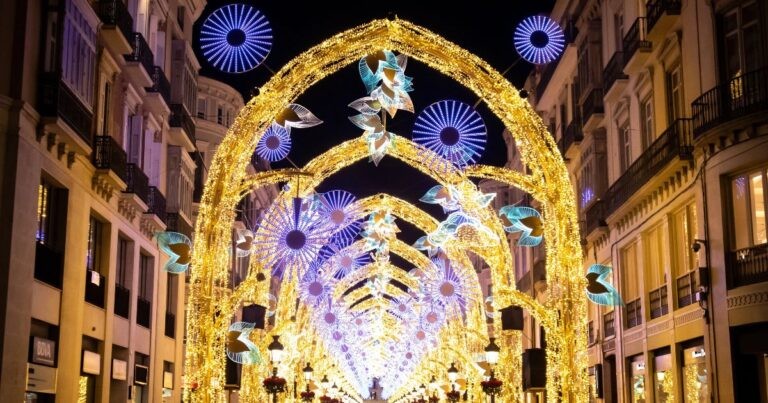
Malaga’s famous illuminations and other surprising Christmas traditions in Spain
Christmas in Spain has a rhythm all of its own: it begins with illuminations and Christmas markets, includes the Christmas Lottery draw, which takes…

The celebrations of All Saints’ Day and All Souls’ Day in Spain are far more varied than in Poland. In Andalusia, you can take part in the ‘procession of souls’, watch a competition for the prettiest figurines made from… food, and try roasted chestnuts. Día de Todos los Santos is deeply rooted in the Catholic faith in Spain. In Andalusia, the celebrations take on a local flavour, combining prayerful reflection with family gatherings, and traditional solemnity with humour and a satirical take on life.
What will you read about in this note?
The first thing that probably springs to mind when thinking of the Spanish language and All Saints’ Day is the Mexican Día de Muertos, or Day of the Dead. It is celebrated on 2 November (although the festivities begin the day before), which is the same time as in Poland, yet it is completely different in character to our All Souls’ Day. We remember the dead in an atmosphere of contemplation, whilst Mexicans do so in a cheerful manner. They dress up in traditional costumes and feast with family and friends.
In Andalusia, and indeed throughout Spain, the celebrations aren’t as lavish as in Mexico, but they are definitely more joyful and varied than in Poland. Of course, Spaniards also visit the graves of their loved ones. Interestingly, Spanish cemeteries are dominated not by individual gravestones but by columbaria – flat walls housing numerous urns. Secondly, it is not customary to bring candles; instead, it is common to leave flowers by the grave. However, the celebration does not end with a visit to the cemetery.

1 November begins throughout Spain with a visit to the cemeteries. At dawn, families make their way to the resting places of their loved ones with colourful bouquets of flowers, mainly chrysanthemums, which in Spanish culture symbolise, on the one hand, life and death, and on the other, remembrance. The graves are thoroughly cleaned, and the cemeteries are transformed into a sea of flowers and burning candles. The atmosphere is solemn, but not sad – rather warm and full of respect. It is a time for remembrance, prayer and contemplation. To ensure everyone can take part, the authorities in some towns organise special buses to take residents to the cemeteries. It’s worth checking this information on your local council’s website.
After the morning ceremonies, families return home or to their campo (a country estate or a cottage outside the city). There, they light their stoves, prepare traditional dishes and spend the rest of the day chatting and having fun. These gatherings symbolise the true spirit of Todos los Santos: family ties, gratitude for life and a sense of continuity between generations. It is not a day of mourning, but a joyful celebration of life and family togetherness.
The most original way of celebrating has taken root in Cádiz.
At the city’s largest markets (Mercado Central and Mercado Virgen del Rosario), displays are set up that are somewhat reminiscent of the Christmas nativity scenes familiar from Polish churches. However, instead of religious figurines, they feature figures created from pieces of food – vegetables and… fish or chicken heads.
This tradition, which originated in Cádiz, is known as Los Tosantos, an abbreviation of the Spanish translation of ‘All Saints’ Day’, namely Día de Todos los Santos. Its history dates back to 1876, when the city authorities decided to boost sales at the Central Market (Mercado Central) and organised a ball. From 1977, traders at the market by Puerta Tierra began decorating their stalls, creating a competition for the best display.
Fantastic scenes are constructed using… foodstuffs: fish heads, seafood, vegetables and fruit. They are usually presented in a satirical vein, with jokes targeting recent events or… ‘silver-tongued’ local politicians. The jury judges the stalls in the categories of fish, meat and vegetables, and awards prizes. Tosantos is also a treat for children – some stalls hand out nuts, fruit and sweets.
In the municipality of Begíjar, situated in the province of Jaén, the locals believe in the journey of souls. According to an old legend, the souls of the dead are said to return to the world of the living on the night before All Saints’ Day. To make their journey easier, the residents of this Andalusian pueblo light oil candles in the windows of their homes. They also protect themselves against evil spirits by plugging the keyhole with gachas, a porridge made from flour, water, salt, olive oil and paprika.
Fans of a dark, mysterious atmosphere will enjoy the celebrations of Día de Todos los Santos in El Borge, situated about 30 kilometres north-east of Málaga. On the evening of 31 October, the Noche de Ánimas, or Night of Souls, begins there. Its highlight is a procession winding through the village streets, with participants dressed in distinctive white robes. They wear hoods on their heads and hold candles in their hands. In this way, they allude to the centuries-old legend of Santa Compaña – a procession of souls whose arrival was said to signal the imminent death of one of the inhabitants of the haunted village. The procession sets off about half an hour before midnight.
We travel a little north of Andalusia, to Extremadura, and specifically to the city of Cáceres. There, roasted chestnuts are a delicacy associated with Día de Todos los Santos and Día de los Muertos. It is said that the first to prepare them were the local altar boys, who wanted to warm themselves up and have a bite to eat whilst ringing the bells early in the morning on 2 November to summon the villagers to the cemetery. Chestnuts have become established as a snack associated with these festivals throughout Spain. You could say that on the Iberian Peninsula they are the equivalent of our ‘Pańska skórka’. The traditional Spanish name for this delicacy is calbote. This is also the name of the fiesta held on 1 November in Cáceres.
As well as chestnuts, the following are traditionally eaten:
Huesos de santo – these are traditional Spanish sweets eaten on 1 November. Their name, which literally means ‘saints’ bones’, refers to their distinctive appearance: white, elongated marzipan tubes that resemble bones – with a thick, yellow filling symbolising bone marrow. The filling is made from egg-yolk cream, and the whole thing has a sweet, almond-and-egg flavour. The traditional recipe for huesos de santo describes in detail the process of preparing the marzipan and the cream, and the sweets themselves are regarded as a symbolic way of commemorating deceased loved ones in Spanish culture.

Buñuelos de viento – these are light, fluffy doughnuts deep-fried in oil, which causes them to expand – hence their name, literally ‘doughnuts made of wind’. They are dusted with icing sugar and cinnamon, and are often filled with custard, chocolate or whipped cream. According to an old legend, every buñuelo eaten frees one soul from purgatory, which gives this dessert symbolic significance. The tradition of making them at this time of year is documented in Spanish chronicles as far back as the 17th century and remains alive in many regions of Spain to this day.
Gachas/poleá – a thick porridge resembling Polish semolina, made from flour, milk and sugar, flavoured with lemon, cinnamon or aniseed. In the past, it was a simple peasant dish, prepared during times of scarcity – particularly in southern Spain. In Andalusia, poleá is a traditional dessert, eaten on All Saints’ Day and symbolising community and remembrance of one’s ancestors. Its roots date back to the Middle Ages, and recipes for similar dishes appear as early as the 13th-century Arabic cookbooks. Gachas or poleá remain one of the most characteristic examples of Andalusian folk cuisine – a tradition cherished to this day.
Whilst we’re on the subject of treats – in Andalusia, as across Europe, children are keen to embrace the American tradition. On 1st and 2nd November, they go round neighbouring houses and flats, dressed in Halloween costumes. In the municipality of El Ronquillo, not far from Seville, an Andalusian version of this tradition from across the Atlantic is practised – Cachetía.
When asking for sweets, the children recite a special rhyme. They ‘threaten’ that if they don’t receive any treats, they’ll ‘stay the whole day’ in the unwelcoming home (Cachetía, tía, tía, como no me dé una castaña, me quedo aquí ‘to’ el día.). Neighbours give them sweets, but also local delicacies: raisins, almonds or the aforementioned roasted chestnuts.
The tradition of collecting sweets has also taken root in the village of Fuente de Piedra, near Antequera, where it is known as La Ureña. It wasn’t borrowed from America, but from local altar boys, who used to knock on people’s doors and ask to be given some food – not necessarily sweet treats.

Maro is a small town situated right next to Nerja, a town very popular with tourists. The combination of its name and the word ‘Halloween’ gave rise to the term used for the local celebrations on the night of 31 October to 1 November – Maroween. Many elements of this festival have been brought to Maro from America, such as the best costume competition and the decoration of houses. The main difference lies in the food – the focus (and most of the treats) is not on pumpkins, but on chestnuts.
In the capital of Andalusia, Seville – specifically in the Santa Cruz district – on All Saints’ Eve, the streets fill with people dressed as Don Juan Tenorio, the title character of José Zorrilla’s 19th-century play. The play itself is staged on this day in many of Seville’s theatres. Why this one in particular? The final act of the drama takes place on All Saints’ Eve in Seville. Moreover, the plot is full of religious and fantastical elements.
Alongside its secular elements, Todos los Santos retains its deeply religious character. Memorial masses are held in churches for the deceased, and the faithful pray for their salvation. The following day, 2 November, is Día de los Fieles Difuntos (All Souls’ Day) – dedicated to the souls who have not yet entered heaven. Together, these two days form a spiritual whole: the first honours the saints, the second – the deceased.
The Costa del Sol is not renowned for particularly lively or original celebrations of Día de Todos los Santos. Here, the best way to get a feel for the Andalusian version of these festivities is to try some roasted chestnuts, which are sold on the streets of Málaga and Marbella at this time of year. You can also celebrate in American style by partying at a Halloween event in one of the countless bars and clubs.
Christmas in Spain has a rhythm all of its own: it begins with illuminations and Christmas markets, includes the Christmas Lottery draw, which takes…
What is worth knowing when travelling to Spain for Christmas? How do Polish and Spanish Christmas traditions differ, and why is the Christmas season…