Semana Santa, or Holy Week in Spain
Easter in Andalusia, known as Semana Santa, is one of the most important and solemn events of the year. The celebrations begin on Palm…
The capital of Andalusia – Seville, often referred to as the “City of Mary” – is world-renowned for its unique Easter celebrations, known in Spain as Semana Santa. Every year, these celebrations draw tens of thousands of tourists from around the world to Andalusia.
What will you read about in this note?
Just like in every country, this special time also has its own unique customs on the Iberian Peninsula, such as:
Black flags: In some processions, you may notice that the Nazarenes carry black flags in their ranks, dragging them along the ground. Their significance is that they cleanse the blood of Christ spilled on the ground.
The oldest brotherhood in Málaga: This is the Real Cofradía de las Fusionadas, founded in 1505, whose origins are linked to the Catholic Monarchs.
The University is represented in the Student Brotherhood: For many years, the University of Málaga has been the honorary “elder sister” of the Student Brotherhood, with which it works closely. Every Easter Monday, university representatives take part in the procession as representatives of the university community.
The Virgin of the Sorrows wears a cloak of flowers: This is the most distinctive cloak of Holy Week in Málaga, and every year the brotherhood weaves a new cloak for its Virgin—made entirely of flowers. The origins of this tradition date back to the brotherhood’s founding, when its founders lacked the funds to purchase a cloak for the throne.
Hoods of the Gitanos Brotherhood: Many of you have likely noticed that the Gitanos Brotherhood, along with the Servitas, is the only one whose Nazarenes do not wear hoods. This is because, in the past, hoods were not as common as they are today, so the brotherhood decided to preserve its origins.
The Origin of the Cautivo’s White Tunic: Originally, the image of Jesus Cautivo was to be displayed as Ecce Homo, but due to the church community and the limited resources available at the time, it was decided to dress him in a white tunic. This coincidence had a huge impact on the image, which to this day remains one of the most resonant throughout Holy Week in Málaga.
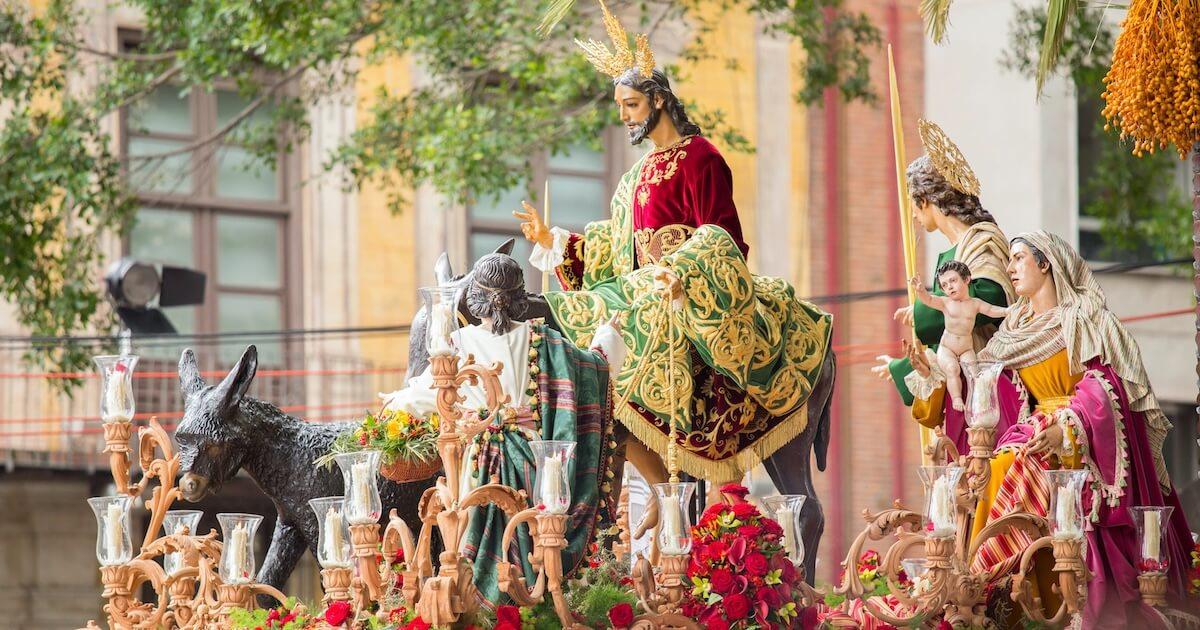
Pollinica: La Borriquita is an affectionate nickname, usually used in reference to the procession of Jesus’ triumphal entry into Jerusalem. Another nickname, “La Pollinica,” is very well known among the residents of Málaga. It comes from the colt (young donkey) on which the Lord stands.
Swords in the Procession: The fact that the procession carries a sword among the ranks of the Nazarenes has a very clear significance. Many centuries ago, some believed that Mary’s conception took place without original sin. Some brotherhoods professing the Marian faith carry a sword as a distinguishing sign of that faith.
The tradition of organizing daily processions as part of Semana Santa in Seville dates back to the 16th century. It was then that Cardinal Fernando Niño de Guevara ordered the local cofradías to prepare an estación de penitencia, or penitential procession, in the local cathedral to celebrate Easter.
Are you wondering what cofradías are? They are local associations of the faithful (laypeople and clergy) whose purpose is to foster Catholic traditions in society and promote religious devotion. In many cases, membership in these brotherhoods is an integral part of family traditions passed down through generations. The brotherhoods are responsible for organizing the celebrations of many religious holidays, but in the public eye, they are best remembered for their preparations for the Semana Santa celebrations.
Each brotherhood is responsible for different tasks on a specific day preceding the Easter celebrations. The immense scale of the processions that wind through the city streets, as well as the fact that they take place throughout Holy Week, requires preparation long before the holidays arrive. During Lent, they meticulously plan the procession route and also tend to the figures and construct the platforms that will participate in the processions.

The Nazarenos are divided into three groups—those carrying candles, those carrying insignia, and those carrying the cross. The most distinctive insignia include: cruz de guía (the guiding cross), banderas de pasos (flags), and estandartes marianos (Marian banners).
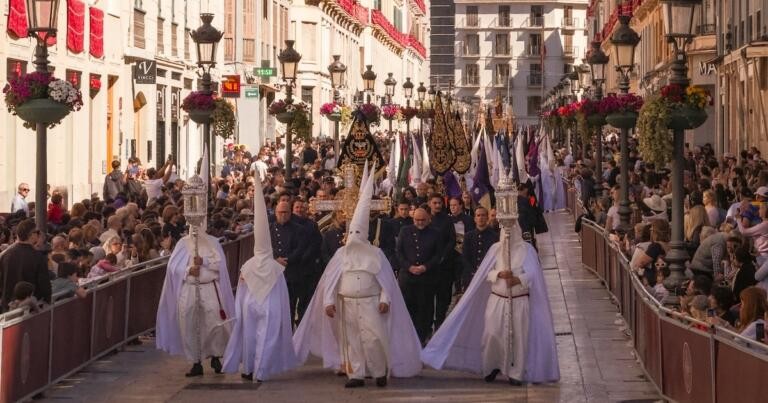
It is the Nazarenos who are the most distinctive group among all those walking in the procession (with the exception of the priests), thanks to their unique attire – they wear long robes and the so-called capirote, a mask with a pointed hood that effectively covers the face. It has a penitential character, and the full coverage of the face ensures that those watching the procession cannot see who is walking in it.
The so-called costaleros, members of various brotherhoods, also play a significant role in the entire event. They carry on their shoulders the paso—a massive structure consisting of an ornate platform with figures depicting a saint or a biblical scene.
Another essential element of every procession are the so-called acolytes, or people whose role is to assist the priests. During the procession, they carry lit candlesticks, which they raise while marching and lower when the procession stops. Some of them also carry incense, characteristic of Catholic rites. In front of them and in front of the paso are the so-called pertigueros—people holding a silver staff or pole, which they use to give commands to the acolytes.

The residents of the capital of Andalusia begin the Semana Santa celebrations on Viernes de Dolores, or the Friday preceding Palm Sunday – this year, it will be the evening of March 27–28. An essential element of the celebrations is the estación de penitencia, organized by the brotherhoods: Pino Montano (named after one of the districts), Pasión y Muerte (Passion and Death), and Cristo de la Corona (Christ of the Crown). These are processions in which participants visit at least one church during the march.
To celebrate this day, the faithful from various neighborhoods follow designated routes and return to the starting point – in this respect, it is no different from the processions we know from Poland.
However, each of the processions taking place in Seville differs from the others in significant details; for example, in the Pino Montano district, residents walk in a procession behind the figures of Jesus of Nazareth and Our Lady of Love, whereas in the Triana district, the Pasión y Muerte brotherhood sets out with the figure of Christ crucified, then proceeds to the Church of St. Anne. Meanwhile, the Cristo de la Corona brotherhood departs from the local cathedral, carrying a 16th-century figure of Christ with a crown of thorns through the center of Seville. All brotherhoods pass through the following points:
The following day (March 28), Andalusians celebrate Sabado de Pasión (Passion Saturday). On the streets of Seville, one can then see the so-called Cruz de Guía – a crucifix carried by one of the brothers at the head of the procession. The first musical groups with trumpets and drums also appear at this time. The main celebrations begin with the Palm Sunday ceremony, commemorating Jesus’ entry into Jerusalem – this year on March 29. As many as 71 brotherhoods will participate in this year’s processions.
The Semana Santa program also includes processions every day of the week, starting with Lunes Santo (Holy Monday, March 30). Processions may begin in the afternoon and end even several hours after midnight the following day.
On the night from Holy Thursday to Good Friday – April 2–3 (known in Spain as Jueves Santo and Viernes Santo) – as the sun rises, Spaniards begin to commemorate the Passion of Christ. This is when the most solemn and largest processions of Holy Week in Seville take place, featuring the city’s six most famous brotherhoods.
The Macarena Brotherhood departs at dawn from the Basilica of La Macarena with the figure of Our Lady of Hope and the Baroque statue of Señor de la Sentencia (Our Lord of the Sentence), depicting Christ in chains. You will also be able to see the following brotherhoods in succession: El Silencio, El Gran Poder, El Calvario, Esperanza de Triana, and Los Gitanos.
On Easter Sunday itself (April 5 – Domingo de Resurrección), processions also take place during the day. At dawn, the Resurrección (Resurrection) brotherhood leaves the Church of Santa Marina, carrying the figure of the Risen Lord Jesus and a canopy under which the Virgen de la Aurora (Our Lady of the Dawn) is placed.
The entire procession can be viewed from the side sections, which include seating areas. However, securing a spot without the right connections—such as among members of the various brotherhoods responsible for organizing the procession – is nearly impossible.
To reserve a seat, you must submit an application by the designated deadline (usually in winter) and then go through a lottery process. After being assigned a seat in the lottery, you must pay for and collect your pass. You have to act fast, as the best seats are snapped up several months before the processions begin!
By Easter Monday, in the vast majority of cities, there are no longer any traces of Holy Week celebrations. Life returns to normal, cars and buses return to the streets running as they do on any other day, and colorful flamenco outfits begin to dominate store windows. All thanks to the Feria de Abril – the flamenco festival that begins after the Easter celebrations.
Easter in Andalusia, known as Semana Santa, is one of the most important and solemn events of the year. The celebrations begin on Palm…

Holy Week in Málaga has been designated a festival of international tourist interest. Every year, it attracts thousands of people who come to the…
Other cities in Andalusia also celebrate both Semana Santa and Easter with great pomp. As in Seville, the brotherhoods are responsible for organizing the events. In the city of Huelva, Palm Sunday is a highlight. On Holy Wednesday, the focus is on Marian devotion. On this day, Spaniards pray to the Vírgen de la Victoria and the Vírgen de la Esperanza (Our Lady of Victory and Hope).
In the city of Jaén, a solemn procession takes place on Good Friday. The figure of Nuestro Padre Jesús Nazareno (Our Father Jesus of Nazareth) appears in the streets, clad in a long burgundy robe, bearing a cross and a crown of thorns. In Andalusia’s second-largest city, Málaga, traditional processions featuring so-called tronos (another term for pasos) are popular. These are massive platforms bearing statues of saints. In this regard, Málaga boasts a trono featuring the figure of Jesus on a donkey, which is carried on Palm Sunday during the so-called Pollinica procession (the name comes from the donkey – pollino).
Málaga stands out for one more element not found in other cities: rosemary carpets on the streets through which the processions pass. Additionally, on Good Friday, the city turns off the streetlights so that its residents can admire the glow of the candles carried in the procession. Holy Week processions in Málaga have been organized for 500 years, making them just as unique as those held in Seville.
Naturally, processions take place in most Andalusian cities, regardless of their size or importance to the region. If we don’t visit Seville or Málaga, we can be sure that on the Costa del Sol between March 29 and April 5, we will definitely have the opportunity to watch the Semana Santa celebrations live.
Semana Santa, or Holy Week, is so popular in Andalusia that hotel reservations must be made… six months in advance. Room rates are, of course, higher during this time. It’s not just tourists who flock to the coast – Spaniards themselves eagerly visit the south of the country during this period.
It’s best to have friends in Seville – the first and most crowded city during Semana Santa. If any of our relatives belong to a brotherhood, we can even dream of a seat along the procession route. Wealthier and more distinguished citizens have reserved seats in the stands, known as Los Palcos.