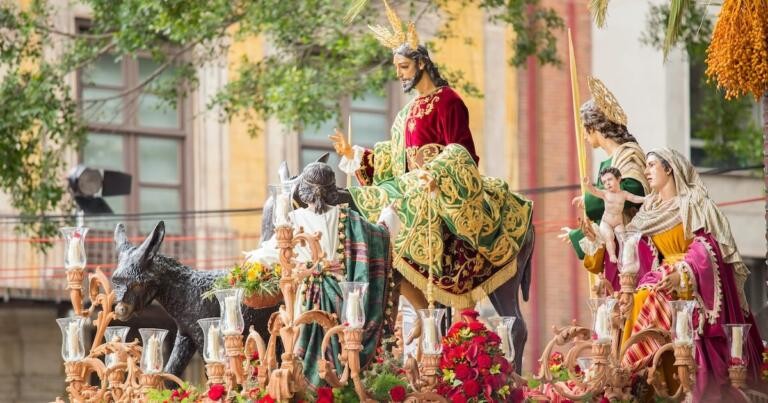
Learn about Easter customs in Andalusia
The capital of Andalusia – Seville, often referred to as the “City of Mary” – is world-renowned for its unique Easter celebrations, known in…
Easter in Andalusia, known as Semana Santa, is one of the most important and solemn events of the year. The celebrations begin on Palm Sunday, when people take to the streets to greet Jesus as he enters the city on a donkey.
What will you read about in this note?
Spain is a country that for centuries was regarded as a bastion of Catholicism. This is evidenced, among other things, by the fact that from the 6th century until the end of the 20th century, it was the official state religion. It is also the country where the famous Spanish Inquisition operated, established in 1480 by the royal couple Ferdinand II and Isabella I, which, after the expulsion of the Muslims from the Iberian Peninsula, was responsible for tracking down more or less suspected deviations from the faith.
Today, the picture of Spain is somewhat different from what it was several hundred years ago, but Catholics still make up almost 70% of the population, so it is hardly surprising that the most important festival – Easter – has been celebrated with great fanfare by the inhabitants of the Iberian Peninsula for hundreds of years.

The Spanish tradition of celebrating Easter differs from the one we know in Poland. Whilst we paint Easter eggs and prepare blessed food baskets, which we then take to church, and shop shelves are bursting with all manner of Easter decorations – bunnies, baskets and chicks – in Spain, the celebration of Easter takes on a more mystical form.
The Easter period in Spain is called Semana Santa, or Holy Week, which begins on Palm Sunday. Whilst in Poland preparations for the holidays are underway, in Spain they are already in full swing. From Sunday to Sunday, processions are organised in most cities, forming the most important part of the celebrations. These events are held on a grand scale, and taking part in them is one of Spain’s traditions.
The city most famous for its Semana Santa celebrations is the capital of Andalusia – Seville, often referred to as the Marian city. The tradition of the city’s processions dates back to the late 16th and early 17th centuries. The first procession was organised in 1604 by the then Cardinal Fernando Niño de Guevara. Today, thousands of tourists from all over the world flock to Seville every year to admire the city’s Semana Santa celebrations.
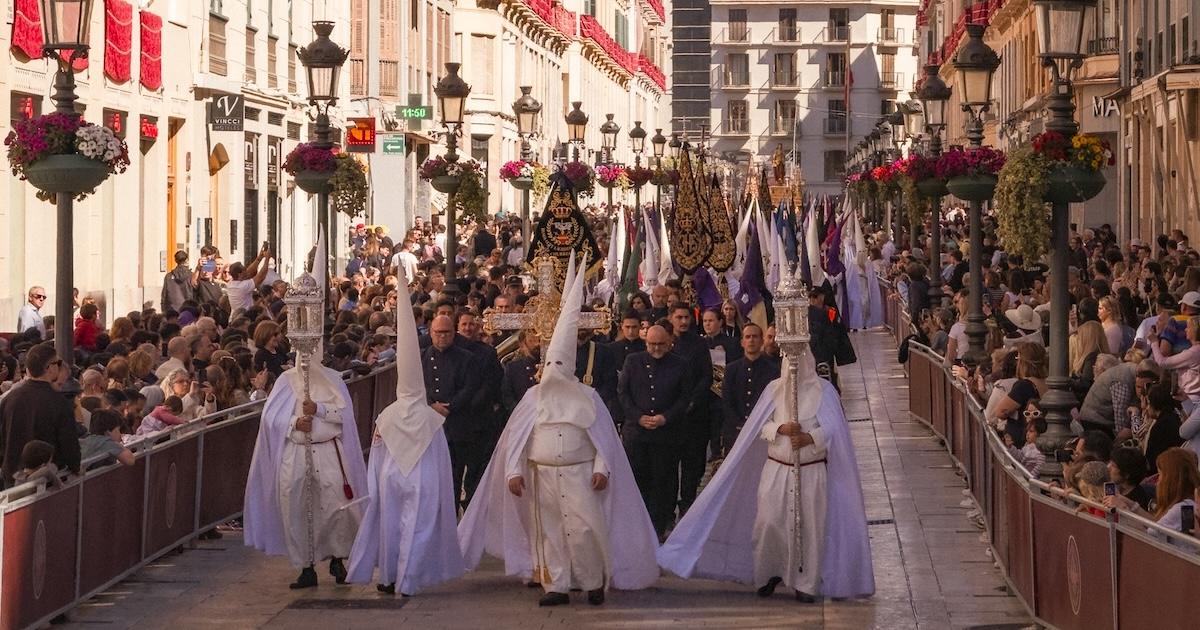
The front of the procession is usually led by a huge, richly decorated cross (cruz de guia), symbolising the Passion of Christ. Music plays an important role in the celebrations, and local marching bands often take part in the processions, performing religious pieces.
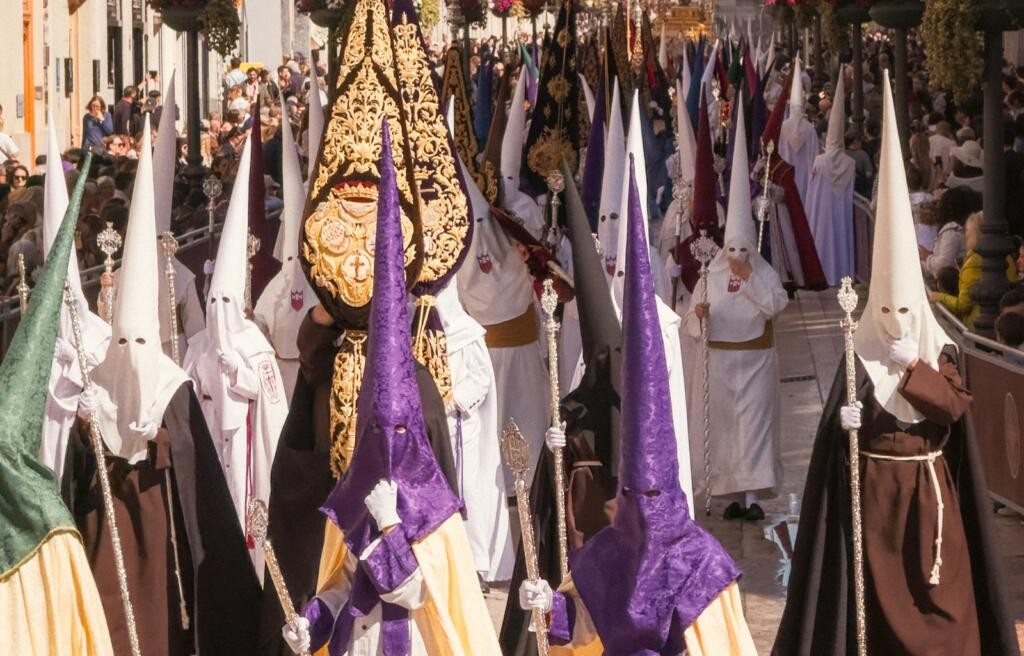
Each participant in the procession is assigned a specific role, and their attire, insignia and accessories are governed by the brotherhood’s internal code. Tourists are usually particularly drawn to the nazarenos, who wear penitential robes (capirote), consisting of distinctive conical hoods covering their heads and faces, as well as loose tunics tied at the waist with a cord or ribbon.
The local capirote stems from a medieval tradition, when they were reserved for penitents who, as a sign of penance for their sins, walked through the city wearing hoods that completely covered their faces so that they could not be recognised as sinners. Women often wear a mantilla, a black lace veil draped over the head and shoulders.
The so-called costaleros also play an important role in every procession; these are men carrying wooden platforms (pasos) on their shoulders, depicting various scenes from the Passion of Christ. Some of the figures carried are even several hundred years old and are considered works of art. The weight of the figures carried should rest on the seventh cervical vertebra, protected by a special piece of fabric. The pace of the procession is set by the so-called capataz, who shows the way to the men carrying the pasos. Capataz, or the throne’s steward, is the true conductor of the procession. Facing the altar, he issues commands to the brothers, directs their movement and pace, and controls the manoeuvres performed with the altar. By striking the bell suspended beside the throne, he signals a few minutes’ rest during the procession and its conclusion.

Organising processions through the streets of Spanish cities is a massive undertaking, for which penitential brotherhoods known as cofradías are responsible. They bring together the faithful – both clergy and laity – belonging to specific parishes. The oldest brotherhoods, still active today, were founded in the 15th and 16th centuries. What distinguishes these associations is their individual code of conduct, as well as the colour of their robes or insignia signifying membership.
Membership of the brotherhoods is passed down from generation to generation – family members regard it as part of their family tradition. Today, the largest parishes have as many as several thousand members, and it is they who actively participate in the processions.

An old tradition, which is now almost unheard of, is the self-flagellation of penitents – the so-called costaleros, those responsible for carrying the platforms (pasos) during the processions. Only men were allowed to take part in this ritual.
Almost 70 brotherhoods currently take part in the Semana Santa celebrations in Seville, meaning that the streets of the Andalusian capital are filled with the most impressive processions throughout the week, admired by tens or even hundreds of thousands of people, including numerous tourists from all over Spain and Europe.
The capital of Andalusia – Seville, often referred to as the “City of Mary” – is world-renowned for its unique Easter celebrations, known in…

Holy Week in Málaga has been designated a festival of international tourist interest. Every year, it attracts thousands of people who come to the…
Málaga celebrates Semana Santa in grand style every year. Residents take part in numerous processions, of which there will be as many as 43 during this year’s celebrations! At the same time, they all follow the same route – it begins at Plaza de Constitución, passes through the Tribuna Principal, follows Marqués de Larios, then the Alameda Principal, touches on the Torre Sur (South Tower) and heads towards the Cathedral. If you want to witness Spain’s most important religious event in all its glory, be sure to line the route.

Palm Sunday (29 March)
The official start of the processions will take place on 29 March, Palm Sunday. The throne will undoubtedly attract the most attention; it will feature the altar of the Cofradía Polinica, depicting Jesus’ entry into Jerusalem on a donkey. On this day, the procession is always attended by large numbers of children – dressed in tunics and carrying Easter palms.
If you happen to take part in the procession amongst the members of the Lagrimas y Favores brotherhood, don’t be surprised if you bump into… Antonio Banderas. The Spanish actor has been one of Andalusia’s ambassadors for many years and proudly takes part in the Semana Santa celebrations.

Holy Monday (30 March)
On Holy Monday, we highly recommend taking part in the incredibly colourful and joyful procession organised by the Gitanos brotherhood. Its members, singing and dancing, follow the throne bearing a dark-skinned Christ. Their procession lasts until 00.30. On this day, the most popular altar of the Captive Christ – El Cautivo – also passes through Málaga. The procession, which lasts until 2.30 am, attracts thousands of people.
Holy Tuesday (31 March)
The longest procession of the entire Semana Santa is organised on Holy Tuesday by the Nueva Esperanza brotherhood. It begins in the afternoon (the procession leaves the Brotherhood House at 3.45 pm) and lasts over 12 hours.
On this day, we will also see the Bride of Málaga – Virgen del Rocío, known as the ‘Bride of Málaga’, that is, the altar of the Rocío brotherhood featuring a figure of Mary dressed in white robes.
An additional eye-catching feature is the woven cloak of fresh flowers in which the figure of the Virgin Mary is draped. The brotherhood begins its procession at 3.00 pm and finishes at 11.30 pm.

Holy Wednesday (1 April)
The processions taking place from Holy Wednesday to Holy Sunday have a more traditional and classical character. On this day, on the streets of Málaga, we will have the opportunity to see a procession in which the faithful carry one of Málaga’s heaviest thronos – the Virgen de la Paloma. It is carried by 290 brothers, and the entire procession is further adorned by the release of doves. The procession will begin at 8.15 pm and end at 1.45 am.
Holy Thursday (2 April)
On Holy Thursday – symbolising the Last Supper – the streets of Málaga will feature the throne with the largest number of sacred figures, tended by members of the Cena (Spanish for ‘supper’) brotherhood (the Brotherhood of the Sacramental Supper of Our Lord Jesus Christ and the Most Holy Mary of Peace). The brotherhood begins its procession at 5.00 pm, finishing at 10.55 pm.
On this day, one of the most popular and famous processions also takes place – Mena, organised by the brotherhood of Cristo de la Buena Muerte. Just like the day before, uniformed personnel – legionnaires – take part in the procession, singing the song ‘Novio de la muerte’ as they carry the cross with Christ, whilst navy soldiers march proudly with the altar bearing Mary. They begin their procession at 6.55 pm and finish at 2.10 am.
Good Friday (3 April)
Good Friday is a day of the utmost solemnity – observed in contemplation. On this day, participants in the Semana Santa celebrations set out from almost all of Málaga’s historic districts, and almost all processions take place without the accompaniment of a band.
One of the most moving processions is that of the Monte Calvario brotherhood, featuring an altar depicting Jesus taken down from the cross in the arms of Mary. The procession begins at 4 pm and ends at midnight. The procession of the Sepulcro brotherhood, however, is the official procession of the entire Holy Week, in which city authorities and representatives of the most important institutions take part. Jesus’s burial is symbolised by a throne with his figure laid upon a catafalque. This year, the brotherhood will march from 7.20 pm to 2.15 am.
The Good Friday celebrations conclude with the procession of the Brotherhood of the Virgin Servitas, featuring an altar dedicated to Mary, which takes place in darkness accompanied by the loud recitation of prayers by its members. This procession ends at 3.30 am.

Easter Sunday (5 April)
Following Holy Saturday without a procession, Holy Week concludes on Easter Sunday with the Procession of the Risen Christ, organised by the Association of Brotherhoods – the governing body of all the brotherhoods in Málaga. Compared to Friday’s celebrations, Sunday’s colourful procession is filled with a joyful atmosphere, and its participants proudly celebrate the Resurrection of Christ.
During the city parade, we can admire the altar of the Risen Christ and Our Lady Queen of Heaven. The procession begins at 10.00 am at the parish church of San Julián (where the procession also ends) and passes through the city centre amidst the cheerful shouts, cheers and applause of the local community and tourists from all over the world.
Easter in Spain also has its own culinary traditions. On the Iberian Peninsula, on Easter Sunday, families first attend Mass and then sit down together at a table laden with, amongst other things: