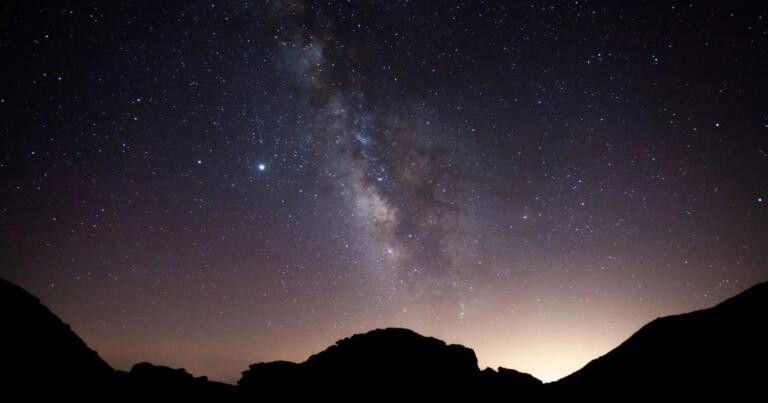
Under the stars of the Sierra Nevada – a summer full of astronomical excitement
In summer, the Sierra Nevada reveals its other, nocturnal side – when the sun dips below the horizon and darkness envelops the mountain slopes.…
On the evening of 12 August 2026, residents and tourists on the Costa del Sol will be able to witness one of the most significant astronomical events of recent years. A total solar eclipse will take place over Spain, although in Málaga it will be visible as a partial eclipse.
What will you read about in this note?
This is a unique event – a total solar eclipse has not been observed in Spain for 121 years. The path along which the Sun’s disc will be 100 per cent obscured will cross the Iberian Peninsula from west to east, covering mainly the northern part of the country. In the south of Spain, including the Costa del Sol, the eclipse will be partial.
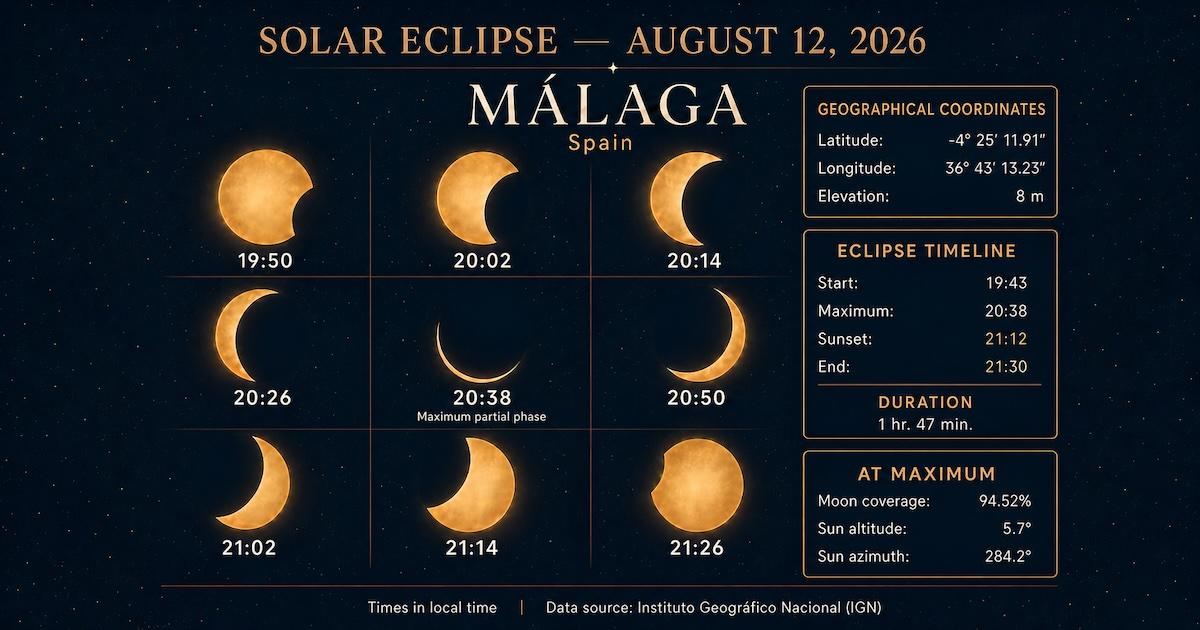
According to data from the Spanish National Geographic Institute (Instituto Geográfico Nacional), the path of the eclipse in Málaga will be as follows:
The whole event will last for about an hour and a half in Málaga. The most spectacular moment will be in the late evening, when the Sun is already low on the horizon.
For this reason, choosing the right viewing spot will be particularly important. Open spaces with an unobstructed view to the west – such as beaches, seaside promenades, viewing points and higher-lying areas away from built-up areas – are best suited for this purpose.
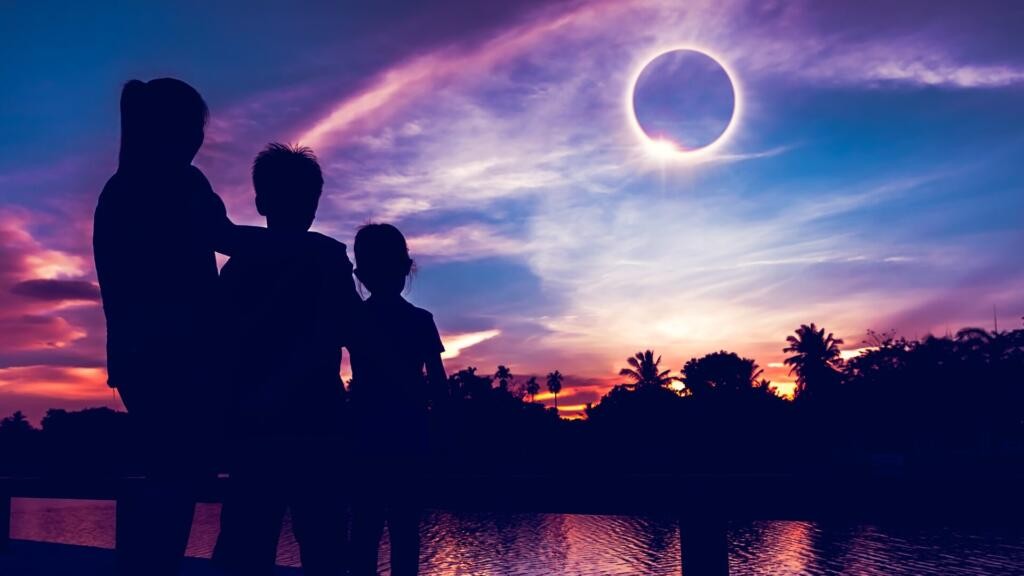
The path of totality will cover almost the entire northern half of Spain. It will run from La Coruña to Palma de Mallorca, passing through, amongst others, Lugo, Oviedo, León, Zamora, Valladolid, Palencia, Segovia, Burgos, Soria, Santander, Bilbao, Vitoria-Gasteiz, Logroño, Guadalajara, Cuenca, Zaragoza, Teruel, Lleida, Tarragona, Valencia and Castellón de la Plana.
The first region of Spain to see the eclipse will be Galicia. In La Coruña, the eclipse will begin at 7.31 pm, reach its peak at 8.28 pm and end at 9.22 pm, shortly before sunset. The total phase will last 76 seconds there, with the Sun 12 degrees above the horizon. The Balearic Islands will be the last part of the country to experience the eclipse. In Palma, Majorca, the peak will occur at around 8.32 pm, when the Sun will be just two degrees above the horizon.
Globally, the eclipse will begin at 17:34 over the Bering Sea and end at 21:58 over the Atlantic Ocean. The entire event will last 264 minutes, or just under four and a half hours. The path of totality will pass across the Arctic Ocean, north-eastern Greenland, the western tip of Iceland and the Iberian Peninsula. The maximum phase of the eclipse, lasting approximately two minutes and 18 seconds, will occur near Iceland. A partial eclipse will also be visible in the northern part of North America, across much of Europe and in West Africa.
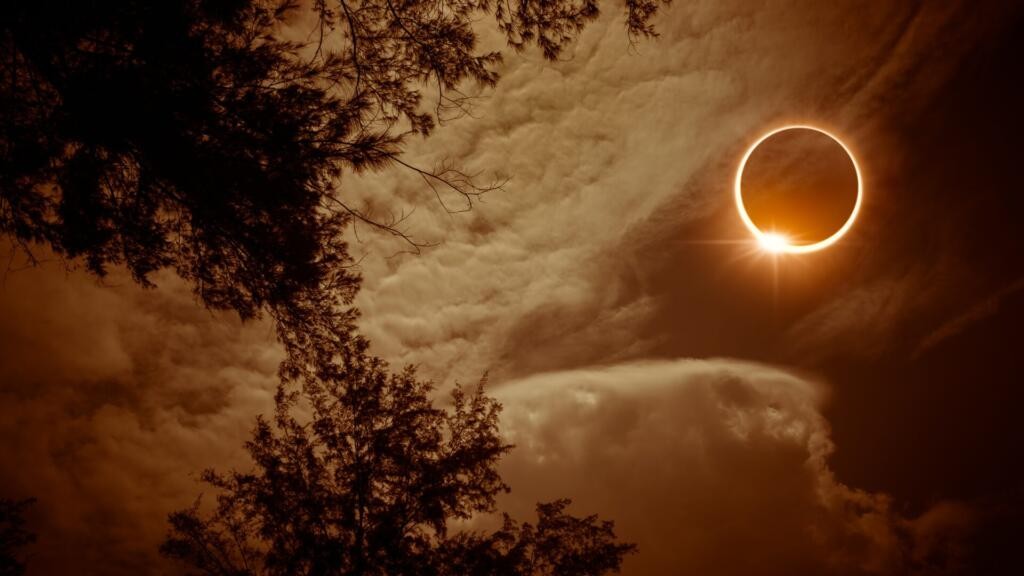
The eclipse will take place in the middle of the holiday season and in the evening just before sunset. For those spending their holidays on the Costa del Sol, it could therefore be a special highlight of their stay – especially as the phenomenon can be observed without having to leave the coast.
However, it is worth finding a spot with a good view of the western horizon in advance and making sure you have the right equipment for safe observation. You should not look directly at the Sun or through ordinary sunglasses.
On 12 August 2026, it’s worth setting aside the evening and choosing a spot in advance with an unobstructed view of the western horizon.
In summer, the Sierra Nevada reveals its other, nocturnal side – when the sun dips below the horizon and darkness envelops the mountain slopes.…
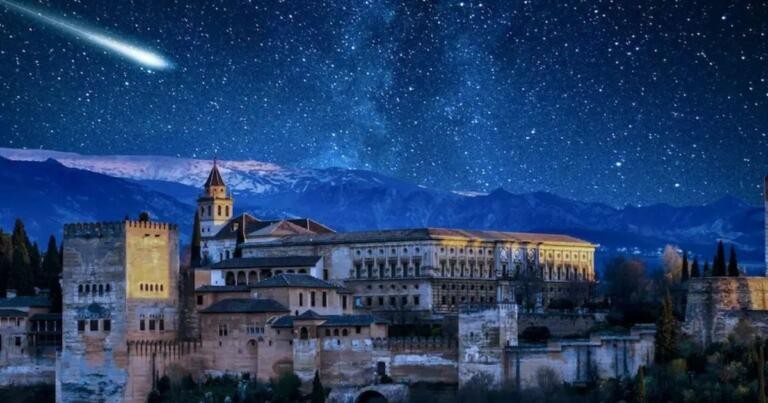
The famous ‘Tears of Saint Lawrence’ will light up the sky again this year. Special stargazing nights in the Sierra Nevada are scheduled for…
No. On 12 August 2026, a partial solar eclipse will be visible in Málaga and on the Costa del Sol. The total eclipse will be visible mainly in the northern part of Spain. In Málaga, the eclipse will begin at 7.43 pm, reach its peak at 8.38 pm and end at sunset at around 9.12 pm.
The eclipse should only be viewed through special glasses fitted with a certified solar filter. Ordinary sunglasses, tinted lenses or looking through a camera or binoculars without a suitable filter will not protect your eyes. In Málaga, it is best to choose a spot with an unobstructed view of the western horizon, as the Sun will be low on the horizon at the time of the eclipse’s maximum.